Iran warns oil blockade will continue untill attack end
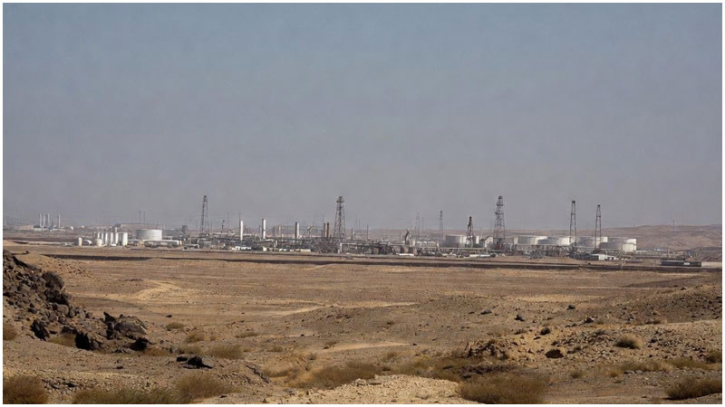
Iran has warned that it will not allow any oil shipments from the Middle East if attacks by the United States and Israel continue, escalating tensions in the ongoing conflict and raising fresh concerns about global energy supplies.
Iran’s Islamic Revolutionary Guard Corps said on Tuesday that “not one litre of oil” would be allowed to leave the region if military strikes against Iran persist. The warning prompted a strong response from US President Donald Trump, who said Washington would respond with far greater force if Iran attempted to block oil exports from the region.
Despite the heightened rhetoric, global markets showed signs of recovery. Crude oil prices retreated sharply and global stock markets rebounded after Trump expressed confidence that the conflict could end quickly.
Speaking on Monday, Trump said the United States had inflicted serious damage on Iran’s military capabilities and predicted the war would end well before the four-week timeframe he had previously mentioned. However, he did not clarify what conditions would constitute victory.
Israel has said its objective is to topple Iran’s clerical leadership, while US officials have largely framed Washington’s goal as destroying Iran’s missile capabilities and nuclear programme. Trump has also suggested that the conflict could only end with a compliant government in Tehran.
According to Iran’s ambassador to the United Nations, at least 1,332 Iranian civilians have been killed and thousands more injured since the United States and Israel launched widespread air and missile strikes across Iran at the end of February.
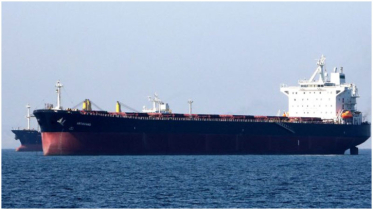
Trump warned that US military action could escalate dramatically if Iran attempted to block tanker traffic through the Strait of Hormuz, a critical shipping route that carries roughly one-fifth of the world’s oil supply.
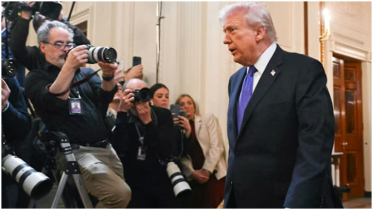
“We will hit them so hard that it will not be possible for them or anybody else helping them to ever recover that section of the world,” Trump said during a news conference.
Iranian officials responded defiantly. A spokesperson for the Revolutionary Guards said Iran would decide when the war ends and dismissed Trump’s remarks as “nonsense,” according to state media.
In a later post on his Truth Social platform, Trump repeated his warning, saying the United States would strike Iran “twenty times harder” if it blocked oil flows through the Strait of Hormuz.
Iran’s Foreign Minister Abbas Araqchi also signaled that Tehran was unlikely to return to negotiations with Washington, citing what he described as a “bitter experience” from previous talks.
He said that after several rounds of negotiations, the United States had acknowledged progress but then proceeded with military strikes, making further dialogue unlikely for now.
The conflict has effectively shut down the Strait of Hormuz for more than a week, leaving oil tankers stranded and forcing some producers to halt pumping as storage facilities fill.
The appointment of Mojtaba Khamenei as Iran’s new supreme leader on Monday was widely seen as a sign of defiance and initially sent oil prices soaring while global stock markets fell. Markets later reversed course after Trump suggested the war might end soon and hinted at possible easing of sanctions on Russian energy.
Following a conversation with Russian President Vladimir Putin, Trump said the United States may waive certain oil-related sanctions on some countries to help ease supply shortages. Analysts say that could involve further easing restrictions on Russian oil, potentially complicating Western efforts to pressure Moscow over its war in Ukraine.
Other options under consideration include releasing oil from strategic reserves or restricting US energy exports to stabilize markets.
Brent crude futures fell by more than 10 percent on Tuesday after surging as much as 29 percent the previous day to their highest level since 2022. Global stock markets also recovered following the sharp swings in oil prices.
Rising fuel costs have become a sensitive political issue in the United States ahead of the November midterm elections. A Reuters/Ipsos poll released on Monday showed that 67 percent of Americans expect gasoline prices to increase in the coming months, while only 29 percent support the war.
On the ground, the conflict continued to intensify. Thick black smoke was seen over Tehran after an oil refinery was struck, raising concerns about environmental and health risks. World Health Organization chief Tedros Ghebreyesus warned that the fire could contaminate food, water and air supplies.
Turkey said its air defence systems shot down a ballistic missile fired from Iran that briefly entered Turkish airspace, marking the second such incident during the conflict. Iranian authorities did not immediately comment.
Israel’s military said it had launched new attacks in central Iran and also struck targets in Beirut, expanding its campaign after Iran-backed Hezbollah forces fired across the border from Lebanon.
Meanwhile, five players from Iran’s women’s national football team were granted humanitarian visas in Australia after seeking asylum over fears of persecution at home. The Australian government has also pledged to send military surveillance aircraft to the Middle East and missiles to the United Arab Emirates to help defend against potential Iranian attacks.
.png)