Oil rises above $110 as Iran war disrupts global supply fears

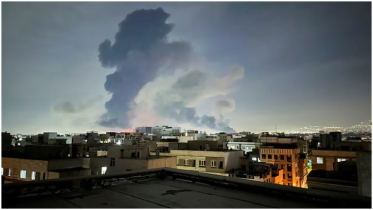
Oil facilities in Tehran were hit by airstrikes at the weekend
Global oil prices have surged past $110 (£82.74) per barrel as the escalating conflict involving the United States, Israel, and Iran raises concerns about prolonged disruptions to oil shipments through the Strait of Hormuz.
Iran on Sunday announced Mojtaba Khamenei as the successor to his father, Ali Khamenei, as Supreme Leader, indicating that hardline leadership remains firmly in control a week into the conflict.
Over the weekend, the United States and Israel carried out fresh waves of airstrikes across Iran, striking multiple targets including oil depots and energy infrastructure.
The conflict threatens major disruptions to energy supplies from the region, potentially driving up costs for consumers and businesses worldwide.
By Monday morning in Asian markets, Brent crude had risen nearly 24% to $114.74 per barrel, while Nymex light sweet crude jumped more than 26% to $114.78.
Roughly one-fifth of the world’s oil supply normally passes through the Strait of Hormuz, but shipping traffic through the narrow passage has nearly stopped since the war began a week ago.
Market analysts had predicted oil prices might cross $100 per barrel this week, but the surge happened far faster than expected. Prices jumped 10% within about a minute of early Asian trading and climbed another 10% roughly 15 minutes later.
Until recently, markets appeared relatively calm despite fears that millions of barrels of crude oil and liquefied natural gas could become stranded in the Gulf if shipping routes were blocked.
However, the latest escalation and visible damage to energy infrastructure in Iran and across the Gulf region triggered a sharp reaction from traders.
Some analysts warn that if the shutdown of the Strait of Hormuz continues until the end of March, oil prices could climb to record levels above $150 per barrel.
Adnan Mazarei of the Peterson Institute for International Economics said the surge in prices was expected given halted production in parts of the Gulf and signs the conflict could drag on.
“People are realising that this won't end quickly,” he said, adding that assurances and goals outlined by the United States are increasingly appearing unrealistic.
Higher oil prices could also drive up the cost of related products such as jet fuel and key chemical inputs used in fertilizer production.
Most of the physical oil supplies from the Gulf are consumed in Asia. Early signs show Asian buyers are already competing for U.S. gas supplies, with some tankers initially heading to Europe turning around mid-Atlantic.
U.S. President Donald Trump responded to the price surge by saying short-term increases were a “small price to pay” for eliminating Iran’s nuclear threat.
His energy secretary also told U.S. media on Sunday that Israel, rather than the United States, was responsible for targeting Iran’s energy infrastructure, amid concerns about rising fuel prices for American consumers.
.png)