Iran strikes threaten Myanmar Junta's jet fuel and drone supplies
Iran’s ongoing retaliation to the joint assault by the United States and Israel will disrupt Tehran’s ability to supply jet fuel and military drone technology to Myanmar’s regime, according to military analysts and international rights groups.
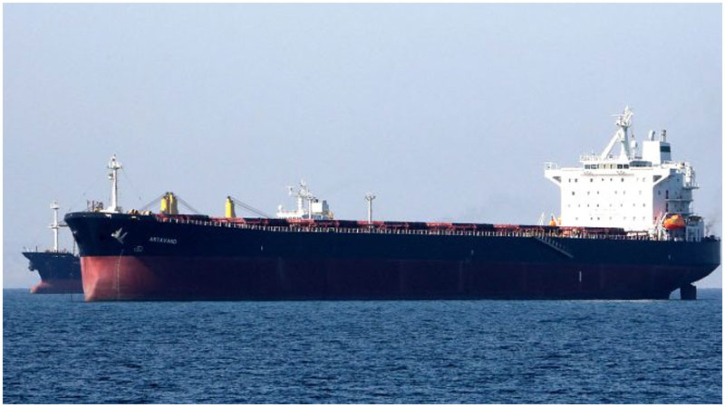
Recent investigations by Amnesty International and Reuters revealed that Iran-linked “ghost ships” transported aviation fuel to Myanmar’s Western-sanctioned military regime in 2024 and 2025, driving the junta’s daily airstrikes on pro-democracy rebels and civilian targets.
Iran also transported military drones on cargo flights to Myanmar following the 2021 coup. Secret military cooperation between Tehran and Naypyitaw reportedly began after the 2021 coup and has deepened over time as the regime strengthened ties with Iran.
However, recent US and Israeli attacks on Iranian ports have likely disrupted the jet fuel supply to Myanmar’s regime, analysts said.
Amnesty International’s co-Regional Director Montse Ferrer told The Irrawaddy on Tuesday that Myanmar’s fuel supplies have been dealt a double blow, after major carriers suspended operations in the Strait of Hormuz, where 20 percent of global oil supplies pass through a chokepoint between Iran, Oman and the UAE.
“Any supply chain – like the one we documented – that relies on the Strait of Hormuz as a transit point will face serious impacts. In addition, if the fuel was from Iranian ports, then the impact would be even more severe, with suppliers potentially no longer able to provide jet fuel,” Ferrer said.
Amnesty warned that the regime could now pivot back to Southeast Asia to secure fuel from previous its suppliers in Vietnam, Thailand, Singapore, China and Malaysia.
The onslaught by US and Israeli forces would also degrade Tehran’s ability to export arms, a Myanmar military analyst told The Irrawaddy.
“The ongoing crisis could cut off not only the supply of jet fuel by ghost ships but also the export of drones to the regime,” he said.
The regime is attempting to offset international sanctions by reviving operations at domestic refineries, including the Thanlyin Oil Refinery, to produce its own jet fuel, according to Nay Win Aung, a former air force sergeant who defected to Civil Disobedience Movement (CDM) following the 2021 coup.
Former major Swe Taw, a fellow defector, warned that the regime would turn to its key allies Russia and China for jet fuel if Iranian supplies were cut.
David Mathieson, a Myanmar affairs analyst, said that because Naypyitaw-Tehran ties are more transactional than strategic, the junta may attempt to secure jet fuel from alternative sources.
Justice for Myanmar (JFM) said it was tracking the Mideast conflict’s impact on jet fuel supplies to the junta, not only from US and Israeli attacks on Iran but also from possible Iranian retaliation against the UAE, whose companies have been involved in multiple fuel shipments to Myanmar.
The rights group said it was also watching other potential supply routes, given the regime and its jet fuel suppliers had developed various strategies to dodge sanctions and maintain supplies of fuel used in deadly airstrikes.
“This [sanction evasion strategies] will no doubt continue as long as countries around Myanmar continue to be complicit in its international crimes by allowing the junta and its cronies to procure aviation fuel and access their banks,” said JFM spokesman Yadanar Maung on Monday.
The group also called on governments to cut the junta’s funding sources and aviation fuel supply by sanctioning ships, their owners and operators, fuel terminals, and Myanma Petrochemical Enterprise, and to follow Canada in banning the export, sale, supply and shipment of jet fuel to Myanmar.
“The junta’s air force depends on imported aviation fuel to bomb civilians,” said Connor Macdonald from the Special Advisory Council for Myanmar (SAC-M). “Its fighter jets and helicopters cannot fly without it. States must do more to disrupt this supply chain and undermine the junta’s capacity to commit atrocities.”
He called on the UK, Canada, the EU, the U.S. and Australia to expand sanctions on vessels and companies supplying aviation fuel to the junta, adding that stronger coordinated enforcement with ASEAN and neighboring countries was essential.
Reuters’ recent investigation revealed that two ghost ships, Reef and Noble, conducted nine shipments from October 2024 to December 2025, delivering a total of about 175,000 tons of jet fuel to Myanmar.
Amnesty also said that Chinese-flagged Huitong 78 delivered jet fuel to Myanmar in July 2024, one of at least 10 shipments made by the same vessel in 2023 and 2024. The vessel likely loaded in Fujairah’s offshore anchorage areas in the United Arab Emirates. Another Chinese-flagged vessel, Yong Sheng 56 (since renamed LS Mercury) also delivered jet fuel to Myanmar in late July 2024, weeks after loading at the UAE offshore area, Amnesty said.
Citing Myanmar Port Authority data, it said at least 109,604 tons of aviation fuel were imported to Myanmar in 2025 alone, a 69 percent increase from 2024 and the highest amount in any year since the coup despite sanctions.
As of Feb. 28, the regime had conducted a total of 10,348 airstrikes—mostly on civilian targets such as villages, towns, schools, hospitals, and religious sites across the country—killing 4,991 people including 678 children and injuring 6,863 others including 1,002 children, according to data compiled by the Human Rights Ministry of the civilian National Unity Government (NUG).
Source: Irrawaddy
.png)