China exports jump 21.8% in early 2026 as trade surplus hits record
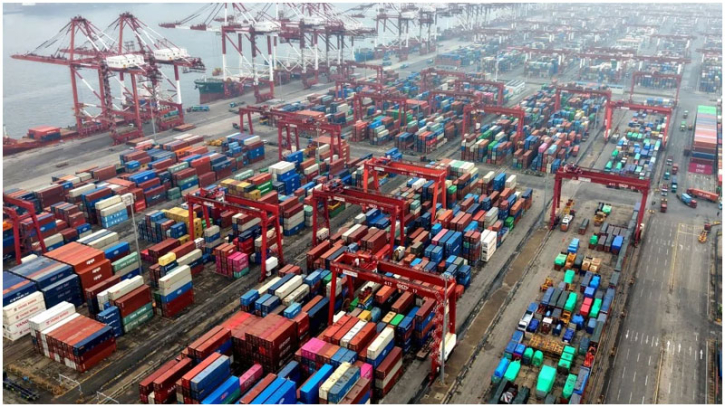
China’s exports surged at their fastest pace in four years during the first two months of 2026, pushing the country’s trade surplus to a record level and highlighting the resilience of the world’s second-largest economy despite ongoing trade tensions with the United States.
According to data released by China’s customs authorities on Wednesday, exports rose 21.8 percent year-on-year in the combined January–February period, far exceeding economists’ expectations of 7.1 percent growth in a Reuters poll.
China typically combines trade data for January and February to smooth out distortions caused by the shifting dates of the Lunar New Year holiday.
The country’s trade surplus reached $213.62 billion during the period, well above the forecast of $179.6 billion.
Imports also recorded strong growth, increasing 19.8 percent compared with the same period a year earlier, significantly higher than the 6.3 percent growth expected by analysts.
Government data showed that trade with the United States declined sharply by 16.9 percent to 609.71 billion yuan, or about $88.22 billion, compared with the same period last year. However, China’s trade with other major partners expanded strongly.
Trade with the European Union climbed 19.9 percent to 998.94 billion yuan, while trade with the Association of Southeast Asian Nations (ASEAN) rose 20.3 percent to reach 1.24 trillion yuan.
The strong trade figures came as China’s consumer inflation also recorded its biggest increase in more than three years, supported by higher spending during an extended holiday period.
China’s consumer price index (CPI) rose 1.3 percent in February from a year earlier, exceeding economists’ forecasts of a 0.8 percent increase. The rise followed a 0.2 percent increase in January and marked the strongest rebound since January 2023.
Zhiwei Zhang, president and chief economist at Pinpoint Asset Management, said the stronger-than-expected export data may partly reflect the relatively late Lunar New Year this year, which could have boosted year-on-year comparisons. However, he added that the timing of the holiday alone likely cannot fully explain the strong performance.
Zhang noted that the robust export growth, combined with the relatively modest economic growth target announced by Beijing during the annual “Two Sessions” policy meetings, suggests the government may not feel the need to introduce major additional stimulus in the near term.
At the meeting, Chinese Premier Li Qiang set the country’s economic growth target for 2026 at between 4.5 percent and 5 percent, the lowest target range since the early 1990s.
The trade data also comes as Beijing continues to navigate its economic relationship with Washington amid lingering tariff disputes.
China and the United States have been engaged in a prolonged trade conflict since US President Donald Trump returned to office in January 2025, with both sides imposing and adjusting tariffs on each other’s goods throughout last year.
However, relations showed signs of improvement following a meeting between Trump and Chinese President Xi Jinping on the sidelines of the Asia-Pacific Economic Cooperation (APEC) summit in Busan, South Korea, in October.
Currently, US tariffs on Chinese goods stand at the global baseline level of 10 percent after the US Supreme Court struck down some tariffs introduced by Trump under the International Emergency Economic Powers Act.
Nevertheless, earlier tariffs imposed under Section 301 of the Trade Act of 1974 and Section 232 of the Trade Expansion Act of 1962 remain in place for several products, with rates reaching as high as 100 percent.
According to business intelligence firm China Briefing, the combination of multiple tariffs means the effective tariff rate on many Chinese goods exported to the United States remains close to 30 percent, still the highest level applied to any major trading partner.
.png)