Bangladesh tops EU garment export growth for 5th consecutive year
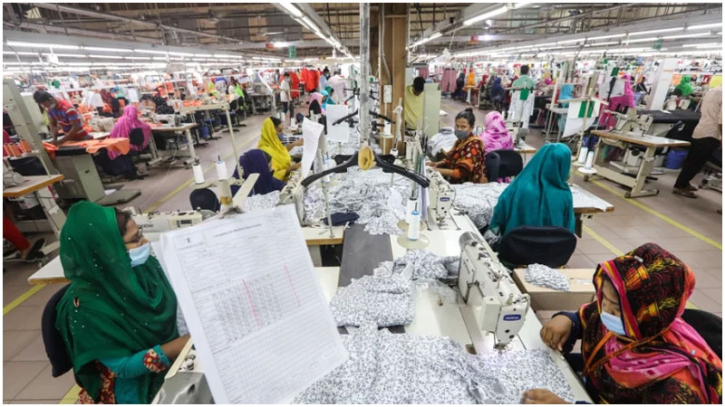
Bangladesh has maintained its lead in readymade garment (RMG) export growth to the European Union for five consecutive years, strengthening its position in the bloc’s expanding apparel market.
Data from the EU’s statistical agency Eurostat show that while the EU’s total RMG imports grew by 24.56 percent between 2021 and 2025, Bangladesh outperformed most major competitors in terms of export growth during the same period.
The EU’s total garment imports rose from €72.25 billion in 2021 to €90 billion in 2025. Although the market dipped in 2023 after peaking in 2022, overall growth over the five-year period remained substantial. Bangladesh not only benefited from this expansion but also increased its market share.
Bangladesh’s RMG exports to the EU climbed from €14.30 billion in 2021 to €19.41 billion in 2025, marking a 35.81 percent increase. In comparison, China’s exports grew by 21.48 percent, from €21.88 billion to €26.58 billion, while India posted growth of 33.18 percent. Turkey, meanwhile, saw exports decline by 9.48 percent over the same period.
The figures indicate that Bangladesh surpassed key competitors in growth rate, consolidating its position as the second-largest apparel supplier to the EU and a leader in sustained expansion.
In the most recent two-year period, however, growth in the overall EU garment market slowed. Between 2024 and 2025, total EU imports increased by just 2.10 percent, reflecting global inflation, weak consumer confidence and economic slowdown in Europe.
Despite these challenges, Bangladesh recorded 5.97 percent growth during the period, compared with China’s 1.17 percent increase and a 10.73 percent decline for Turkey. This suggests that Bangladesh’s relative competitiveness strengthened even as market conditions became tougher.
Toward the end of 2025, exports from Bangladesh entered negative territory in the second half of the year, mirroring a broader slowdown seen in Europe and China. However, the decline for Bangladesh was sharper, partly due to intense price pressure in the European market. Retailers pushed for lower prices, resulting in reduced average export values.
Even under these conditions, Bangladesh increased export volumes. As European buyers sought larger quantities at lower prices, the country leveraged its large-scale production capacity and stable supply chains to meet demand. While China also offered significant price concessions, Bangladesh managed to expand its overall market share.
Among other Asian exporters, Cambodia posted notable growth of more than 88 percent over five years, while Vietnam and Pakistan also performed strongly in recent years. Still, in terms of scale and consistent growth, Bangladesh retained a leading position.
Industry analysts say sustaining this leadership will require a strategic shift. While volume growth has been strong, long-term competitiveness will depend on value addition, product diversification, sustainable production and entry into higher-value segments.
With price pressures persisting and demand growth moderating, reliance solely on supplying larger volumes at lower prices may not be viable. Although Bangladesh’s performance in the EU market over the past five years highlights its resilience and strength, recent slowdowns underscore the need for qualitative transformation to secure future growth.
.png)