Trump has big plans for Venezuela's oil but are they feasible?
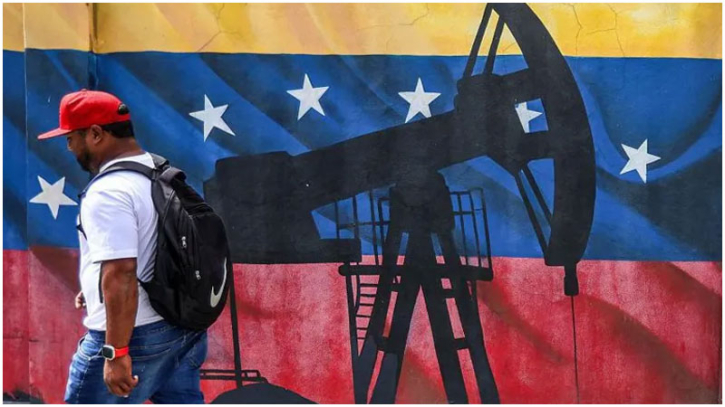
After US President Donald Trump oversaw the seizure of his Venezuelan counterpart Nicolás Maduro last month, he vowed to tap the country's oil reserves – the world's largest.
Trump now says that he plans to visit the South American country, although no date has been set.
His comments, made last Friday, came after US Energy Secretary Chris Wright completed a two-day trip to Venezuela to see how the nation is starting to reopen its oil sector to US companies.
Wright's visit came shortly after Venezuela's National Assembly passed a law to allow both private and foreign investment in its oil industry, following two decades of tight state control.
In Trump's eyes it is a big business opportunity for the US oil sector. "We're going to be extracting numbers in terms of oil like few people have seen," he said at a news conference in mid-January, after a meeting with energy bosses at the White House.
But for the US oil firms that Trump wants to invest heavily in Venezuela, the question is a simple one - do the numbers add up?
William Jackson, chief emerging markets economist at Capital Economics, says the US president's aim is to "revive Venezuela's oil sector and use that energy to increase supply and reduce costs to the consumer, possibly providing a source of revenue for a more friendly Venezuelan government to rebuild the economy after years of mismanagement".
For US energy companies, however, there are huge practical difficulties to be overcome. Venezuela's state-owned oil company, PDVSA, is a shadow of its former self.
The governments of Maduro and his predecessor, Hugo Chávez milked the firm for all it was worth, and used the money to finance social spending on housing, healthcare and transport.
But they failed to invest in maintaining oil production levels, which have plummeted in recent years – partly, but not solely, because of US sanctions, which could now be revised.
"In Venezuela, you're dealing with equipment that's been degraded by many years of neglect," says Jackson. "Ten to 15 years ago, Venezuela was producing 1.5 million barrels a day more than it does today."
Monica de Bolle, senior fellow at the Peterson Institute for International Economics, agrees that PDVSA is in a parlous state.
"A lot of things have to be scrapped completely and rebuilt from the ground up," she tells the BBC. "In fact, if political constraints did not matter, the best thing to do would be to scrap PDVSA, but that isn't going to happen.
"It's a big nationalist symbol, it's attached to sovereignty. Would the Venezuelans be willing to do whatever the US says and roll over? I don't think so."
Trump has asked US oil firms to spend at least $100bn (£75bn) on restoring Venezuela's battered infrastructure – an absolute necessity before his plan to ramp up sales can be realised.
Officially, Venezuela has 300 billion barrels of oil reserves – yet in 2023, it exported just 211.6 million barrels of oil, worth about $4bn. Compare that to second-placed Saudi Arabia, which has 267 billion barrels of reserves, but had exports worth $181bn in the same time period.
So on paper at least, there is room for improvement. However, Jackson says there are doubts over the true size of Venezuela's oil reserves.
During the Chávez presidency, Venezuela reclassified its reserves. Previously, there were thought to be just 80 billion barrels of extractable oil, but by 2011, its reported figure had nearly quadrupled. That statistical change was made possible by high oil prices at the time, which allowed previously unviable projects to look feasible.
"There was a big step – jump – that people have questioned," Jackson says. "But now the world is awash with oil and it's not clear that the same calculations still apply."
When Chávez became Venezuela's president in 1999, oil prices were climbing. In the early 2010s, a barrel would often fetch about $100, providing the government with plenty of money to pour into social programmes. But with current prices around the $65 mark, the country looks less like a reasonable investment.
Venezuela's oil is also of poorer quality than its Saudi equivalent. Its sour, heavy crude is difficult to extract and refine, while its high sulphur content makes it corrosive to pipelines. A resurgence of Venezuela's industry could pose problems for Canada, which produces similarly viscous oil and exports much of it to the US, but analysts reckon the risk is minor.
According to research by Capital Economics, Canadian oil should remain competitively priced, even if Venezuelan production increases.
In the meantime, Venezuela's economic crisis has led to the exodus of nearly eight million people who have fled in search of a better life.
This includes expertise vital to keeping the oil pumps working: with the skilled engineers formerly on the PDVSA payroll now plying their trade elsewhere, the system limps on with a skeleton staff.
Thomas Watters, managing director and sector lead for oil and gas at research firm S&P Global Ratings, says US firms have the ability to repair Venezuela's infrastructure, but it has to make economic sense.
"At the end of the day, oil and gas companies have to deliver value to shareholders," he says. "They have very good managers. You can build anything, as long as you can pay for it.
"But you need an oil price that makes that worthwhile. Unless you can generate sufficient money to justify that, it's very difficult to see the industry coming back."
Besides, US oil firms have been bitten by Venezuela once before. In 2007, major US companies including ExxonMobil and ConocoPhillips had their assets seized when they refused to allow PDVSA to take majority control.
They went to the international courts and were awarded huge sums in damages – $8.3bn in the case of ConocoPhillips – which have never been paid.
Given that the current Venezuelan regime continues largely intact, with former Vice-President Delcy Rodríguez as interim leader, it will take a lot to dispel fears of renewed expropriation.
Moreover, US Energy Secretary Chris Wright has said the Trump administration has no plans to offer security guarantees to oil companies in Venezuela – a worrying omission in a country where state-sanctioned paramilitary groups known as "colectivos" often operate as criminal gangs.
Without bigger government incentives, oil firms will be reluctant to take what could be an expensive plunge. Small wonder, then, that ExxonMobil boss Darren Woods has called Venezuela "uninvestable" in its current state.
Tellingly, Trump did not come back with an offer of sweeteners to promote investment. Instead, he threatened to block ExxonMobil investment in Venezuela.
The policy is "all stick, no carrot", says de Bolle of the Peterson Institute. "And it doesn't seem like they understand that they do need carrots."
In de Bolle's view, the Trump administration has an "imperialist vision" of Latin America that leads it to see the region's resources as its property. For her, private oil firms' aversion to Venezuela is a welcome barrier to that kind of resource grab.
"This is a time when you think, 'Thank God the US doesn't have a state-owned oil company,'" she says. "They need the private sector, but for the moment, the private sector isn't budging. And what company in their right mind is going to put money into Venezuela?"
But if Venezuela's oil output does eventually surge, could it bring global oil prices down? Analysts refuse to be drawn.
"It depends on the scale at which it happens," says Jackson of Capital Economics.
"The situation is very fluid, very opaque, and there's a big geopolitical angle. We're in the early stages where Venezuelan production is concerned."
.png)