US airlifts microreactor in first test of rapid nuclear deployment
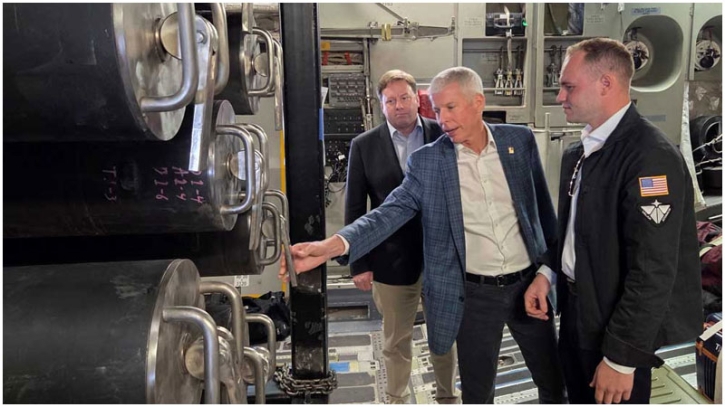
The US Departments of Energy and Defense have completed the first-ever air transport of a nuclear microreactor, flying the compact unit from California to Utah to showcase how quickly nuclear power could be deployed for military and civilian needs.
The reactor, developed by California-based Valar Atomics, was transported without nuclear fuel aboard a C-17 cargo aircraft to Hill Air Force Base in Utah. Energy Secretary Chris Wright and Under Secretary of Defense for Acquisition and Sustainment Michael Duffey accompanied the shipment, calling the operation a milestone for both nuclear innovation and military logistics.
Duffey said the demonstration moves the United States closer to deploying nuclear power “when and where it is needed” to support military operations.
The initiative aligns with President Donald Trump’s broader push to expand domestic energy production, including small nuclear technologies seen as critical for national security and the growing energy demands of artificial intelligence. Last year, Trump signed executive orders aimed at accelerating nuclear development, and the Energy Department later awarded grants to advance small modular reactor projects.
Supporters argue that microreactors could provide reliable electricity in remote or austere locations, offering an alternative to diesel generators that require constant fuel deliveries. The Ward microreactor flown on Sunday is slightly larger than a minivan and is designed to produce up to 5 megawatts of electricity — enough to power roughly 5,000 homes at full capacity.
Valar Atomics plans to begin operating the reactor in July at lower output levels before gradually scaling up. The company hopes to start limited power sales in 2027 and reach full commercial operations by 2028.
However, critics question the economic and environmental viability of such systems. Edwin Lyman of the Union of Concerned Scientists said microreactors are likely to generate electricity at significantly higher costs than traditional large reactors or renewable sources such as wind and solar. He and other experts have also raised concerns about radioactive waste management, noting that even small reactors produce substantial nuclear waste.
Energy officials acknowledged that long-term waste disposal remains unresolved. The department is in discussions with several states, including Utah, about potentially hosting facilities to reprocess or permanently store nuclear fuel.
The department aims to have three microreactors reach “criticality” — the point at which a sustained nuclear reaction occurs — by July 4, underscoring the administration’s ambition to fast-track the technology’s deployment.
.png)