Bangladesh outperforms key rivals in EU garment market
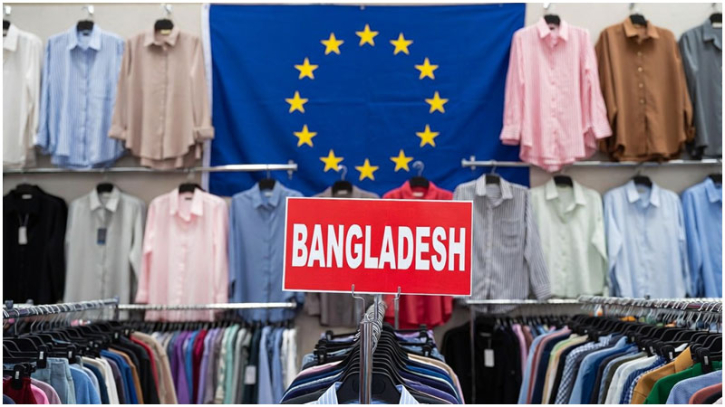
Bangladesh has demonstrated stronger performance than several major competitors in the European Union’s garment market, even as overall import growth in the bloc has slowed in recent years.
Data from Eurostat show that while the EU’s total garment imports expanded between 2021 and 2025, growth momentum weakened in the most recent period. Between 2024 and 2025, the EU’s garment imports from the world increased by just 2.10 percent, rising from €88.15 billion to €90.00 billion.
During the same two-year period, Bangladesh’s exports to the EU grew by 5.97 percent, reaching €19.41 billion from €18.32 billion. In comparison, imports from China edged up only 1.17 percent, from €26.27 billion to €26.58 billion, while imports from Turkey declined by 10.73 percent.
Over the longer five-year span from 2021 to 2025, EU garment imports rose by 24.56 percent, increasing from €72.25 billion to €90.00 billion. Bangladesh recorded growth of 35.81 percent during this period, with exports rising from €14.30 billion to €19.41 billion. China’s exports grew by 21.48 percent, while India posted a 33.18 percent increase. Turkey, however, experienced a 9.48 percent decline, with exports falling from €9.22 billion to €8.34 billion.
Mohiuddin Rubel, former director of the Bangladesh Garment Manufacturers and Exporters Association (BGMEA) and additional managing director of Denim Expert Ltd, said Bangladesh’s nearly 6 percent growth in a market that expanded just over 2 percent in the past two years sends a positive signal when considering the full year’s performance.
He noted that Bangladesh has strengthened its relative position compared to China and Turkey over the long term, reflecting competitive pricing, resilient supply chains and sustained buyer confidence. However, he acknowledged that the sector struggled toward the end of the year.
Although Bangladesh posted positive overall growth for the year, exports turned negative in the second half, which was particularly challenging. Europe as a whole also ended the year on a negative trend, as did China, but the contraction for Bangladesh was comparatively sharper than for some competitors.
Rubel explained that significant price pressure in the European market led to a noticeable drop in export prices. Even so, Bangladesh managed to increase shipment volumes as EU buyers sought to meet demand while aggressively pushing down prices across suppliers.
He added that China’s efficiency and scale allowed it to offer even deeper price reductions to sustain growth. At the same time, with Bangladesh’s political environment now stable and a new government expected to enhance competitiveness, he expressed optimism that the country could perform better in the coming period, provided global conditions do not worsen.
Price pressure has affected nearly all exporting countries, though Vietnam and Turkey have been relatively less impacted compared to others.
.png)