Asian stocks rise with wall street as Seoul shrugs off Trump tariff threat
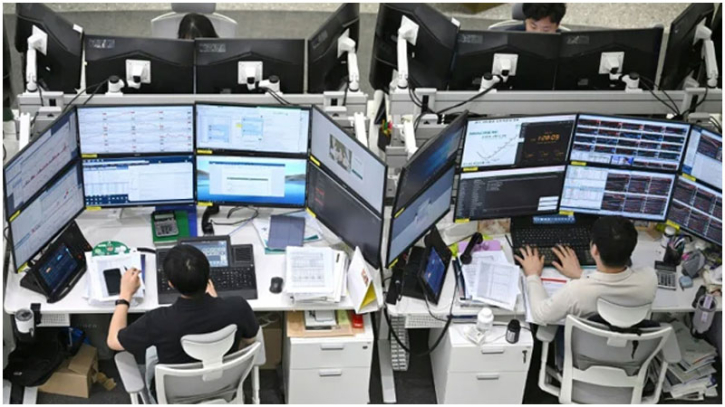
Asian stock markets advanced on Tuesday, tracking gains on Wall Street, as investors largely brushed aside US President Donald Trump’s renewed threat to raise tariffs on South Korean goods. Technology stocks led the rally, pushing Seoul’s benchmark index to another record high.
The Japanese yen held on to gains after a sharp two-day rise driven by speculation over possible market intervention. Meanwhile, ongoing geopolitical and economic uncertainty lifted silver to another record peak, while gold hovered just below its own all-time high.
Investors are also positioning ahead of a closely watched Federal Reserve policy meeting and a wave of earnings from major technology firms, which are expected to offer clues on the durability of the artificial intelligence investment boom.
Equity markets posted solid gains despite Trump’s warning that he could impose tariffs of up to 25 percent on South Korean exports, including automobiles, accusing Seoul of failing to meet expectations under a previous agreement with Washington. The two countries had agreed just months ago to a trade and security deal that set tariffs at 15 percent following tense negotiations.
“South Korea's Legislature is not living up to its Deal with the United States,” Trump wrote on his Truth Social platform. He said tariff rates were being increased because the Korean legislature had not enacted what he called a historic trade agreement.
South Korea’s presidential office said it had not been notified in advance of the remarks. It added that Trade Minister Kim Jung-kwan, currently in Canada, would travel to Washington for talks with US Commerce Secretary Howard Lutnick.
Trump’s comments followed a warning to Canada over the weekend that it could face 100 percent tariffs if it signed a trade deal with China. The warning came just days after he backed away from threatening several European nations with trade measures linked to their opposition to his stance on Greenland.
Despite the rhetoric, South Korea’s Kospi index continued to climb to fresh record highs, with analysts noting Trump’s track record of scaling back his most severe threats. While shares in carmakers slipped, technology stocks surged. Chipmaker SK hynix jumped more than five percent, while Samsung Electronics gained around two percent.
Strong gains were also seen across the region, including in Hong Kong, Shanghai, Sydney, Singapore, Taipei, Manila and Jakarta.
Technology stocks broadly received a fresh boost ahead of earnings reports as investors continued to pile into AI-related plays. Several members of the so-called Magnificent Seven, including Apple, Microsoft, Meta and Tesla, are due to report results this week. Other major companies such as Texas Instruments, Boeing and Mastercard are also expected to provide insight into the health of the broader economy.
However, some caution is emerging as questions grow over the scale of investment flowing into artificial intelligence and how long it will take for profits to materialise.
“The AI capex cycle is increasingly colliding with the real world: debt markets, power grids, and regulation,” said Matt Weller, head of market research at City Index. He noted that capital spending by major technology companies is forecast to exceed $600 billion in 2026, largely driven by AI infrastructure, with firms increasingly turning to debt to finance the race.
“This matters for earnings because the market’s attention is shifting from who spends the most to who can sustain that spending without eroding free cash flow, especially if AI monetisation takes longer than expected,” he said.
Investors are also watching developments in Washington after some US senators warned they could oppose upcoming spending bills following the second killing of a US citizen in Minneapolis, raising the risk of another government shutdown.
The dollar remained under pressure after its latest selloff, triggered by talk of possible joint intervention by US and Japanese authorities to support the yen.
In corporate news, Hong Kong-listed shares of China’s Zijin Gold International rose more than one percent after the company agreed to buy Allied Gold, which owns gold mines in Africa, for $4 billion. Shares in its parent company, Zijin Mining Group, surged more than six percent. Zijin Gold’s stock has tripled since its listing in September.
At around 0230 GMT, Tokyo’s Nikkei 225 was up 0.3 percent at 53,017.71. Hong Kong’s Hang Seng Index gained 1.3 percent to 27,123.67, while Shanghai’s Composite Index edged up 0.1 percent to 4,137.56.
In currency trading, the dollar rose slightly to 154.26 yen. The euro slipped to $1.1877, while sterling eased to $1.3677. In commodities, US crude oil fell 0.5 percent to $60.35 a barrel, and Brent crude dropped 0.6 percent to $65.23 a barrel.
.png)