How the Rakhine war affects Bangladesh's economy?
On February 23, three Bangladeshi-origin members of the Arakan Army (AA), the dominant ethnic armed organization (EAO) in Myanmar’s Rakhine State, were apprehended by the Border Guard Bangladesh while infiltrating Bangladesh through the Chattogram Hill Tracts. Some 168,000 Myanmar kyat (around 9,800 Bangladeshi taka) were recovered from them.
Six days earlier, the AA abducted five Bangladeshi citizens from the vicinity of the Shah Pori Island at the mouth of the Naf River. A day before that, the AA had released 73 out of more than 200 Bangladeshi hostages.
These incidents indicate two of the multitude of economic crimes committed against Bangladesh amid the war in Myanmar’s Rakhine State: namely, currency smuggling and kidnapping for ransom. In fact, the Rakhine war has exerted a considerable negative economic impact on Bangladesh, an issue that has so far remained understudied.
Background of the Rakhine War
Myanmar’s Rakhine State has witnessed a complex armed conflict since the independence of the country in 1948. The current phase of the Rakhine war started on October 27, 2023, when the Arakan Army joined two other EAOs to launch Operation 1027 against the military-controlled Myanmar government.
Since then, the AA has captured more than 90 percent of Rakhine State, including the northern Maungdaw District – the traditional Rohingya heartland – and Paletwa Township in southern Chin State. In doing so, the Rakhine nationalist organization gained control of the entirety of the 271-kilometer-long Bangladesh–Myanmar border, effectively cutting off Myanmar’s government-controlled territories from Bangladesh.
At present, the statelet controlled by the AA and its political wing, the United League of Arakan, is the de facto southeastern neighbor of Bangladesh, and it exerts substantial control over the trade flows between Bangladesh and Myanmar.
The trade volume between Bangladesh and Myanmar is modest, peaking in 2018–2019 at an estimated $223.22 million. In 2024, trade turnover slumped to just $90.1 million, partly due to the disruptions caused by the intensification of fighting in Rakhine. More than 90 percent of Bangladesh’s trade with Myanmar is conducted through two checkpoints in Rakhine State: Sittwe and Maungdaw. Currently, Maungdaw is under the control of the AA and Sittwe, the capital of Rakhine State, is besieged and cut off from the rest of Myanmar. That gives the AA a chokehold on trade between Bangladesh and Myanmar.
Disruptions in Official Trade
The outbreak of a full-scale war between the Myanmar government and the Arakan Army has led to substantial reduction in the bilateral trade between Bangladesh and Myanmar. The AA has imposed an indefinite ban on the movement of vessels in the section of the Naf River near Rakhine State. The AA has also been carrying out indiscriminate seizures of Bangladesh-bound cargo ships arriving from Myanmar’s core territories, and exacting additional taxes from Bangladeshi traders shipping goods from Sittwe to Teknaf. These factors are responsible for this downturn in bilateral trade.
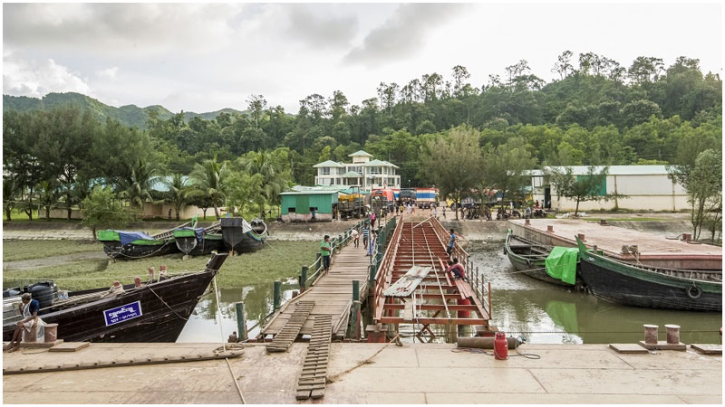
Before November 2023, around 50 cargo ships arrived at the Teknaf Land Port every day. After the capture of Maungdaw District by the AA, the port received only three to five ships per month on average.
In FY2022–2023, Bangladesh imported 188,999 tonnes of goods worth 15.5 billion takas ($126.43 million) from Myanmar, and exported 2,941 tonnes of goods worth 67.2 million takas to its neighbor. However, after the start of Operation 1027, it was reported in November 2023 that the government of Bangladesh was suffering losses worth 30 million takas daily due to the contraction in bilateral trade with Myanmar. Since then, the amount of financial losses has only mounted.
In FY2023–2024, Bangladeshi imports from Myanmar shrank by 62 percent to 71,741 tonnes of goods worth 8 billion takas and exports to Myanmar shrank by 76.1 percent to 704 tonnes of goods worth 24.5 million takas. This demonstrates a substantial decrease in bilateral trade between Bangladesh and Myanmar owing to the Rakhine war.
While Bangladesh’s export basket to Myanmar is small, Bangladesh imports a number of grocery items from its southeastern neighbor. These daily essentials include foodstuffs such as rice, frozen fish, dried fish, coconuts, and pickles, as well as culinary aromatics such as ginger, garlic, and onions.
In particular, Bangladesh, despite being the third largest producer of rice in the world, has to import a large quantity of rice due to growing demand and shortfalls in production, and Myanmar, as the seventh largest producer of rice, has exported rice to Bangladesh for years. In 2025, Bangladesh decided to procure 100,000 tonnes of rice from Myanmar and the United Arab Emirates (UAE). Thus, Myanmar is important for Bangladesh’s food security, but the Rakhine war poses challenges to this symbiotic trade partnership.
Rise in Unofficial Trade and Economic Crimes
In addition to disrupting the official trade flow, the Rakhine War has led to a spike in unofficial economic activities, including black-marketeering, drug smuggling, human trafficking, and a ransom economy. These activities impose on Bangladesh not only social, political, and cultural costs but also steep economic costs.
After the start of Operation 1027, the manpower-deficient Tatmadaw (Myanmar Armed Forces) applied the “four cuts” strategy against the AA. It blockaded Rakhine State to strip the EAO of food, funds, information, and recruitment. Accordingly, the AA now procures all sorts of goods – including foodstuffs, cement, fertilizers, oil, and medicines – from Bangladesh via the black market.
The quantity of goods smuggled from Bangladesh to Rakhine State is substantial, but it has not yet been fully accounted for, as a large portion of the smuggling remains undetected. As a result of this “unofficial” trade, the government of Bangladesh is losing a substantial amount of money in unpaid customs and excise duties.
Meanwhile, a large quantity of narcotics, including methamphetamine (popularly known as yaba) and opiates (such as opium and heroin), is smuggled into Bangladesh from Rakhine State. The AA is reportedly involved in this trade in narcotics. Nearly 80 percent of these drugs are smuggled into Bangladesh via coastal areas, using impoverished Rohingyas as couriers. Just a few days ago, the Border Guard Bangladesh confiscated nearly 1 million methamphetamine tablets from drug smugglers in Cox’s Bazar.
The largely uninterrupted and massive flow of drugs into Bangladesh has turned more than 8.3 million people into drug addicts, leading to a wide range of socio-economic problems, including poverty and a spike in violent crimes. The crisis has necessitated substantial allocation of resources by both the state and individuals to the rehabilitation of drug addicts. Bangladesh reportedly loses $481 million annually due to drug trafficking, and the indirect economic costs of drug addiction are even higher.
Moreover, the actions of the AA in Rakhine State have forced more than 150,000 Rohingyas to flee to Bangladesh, adding to the already existing 1.4-million-strong Rohingya refugee community in the country. This has further strained the volatile economy of Bangladesh, and the socio-economic costs of the escalation of the refugee crisis are incalculable.
In addition, the AA has reportedly facilitated the trafficking of Rohingyas into Bangladesh in exchange for money. Thus, the EAO is profiting off a humanitarian crisis, while Bangladesh is bearing its economic, social, political, and security costs.
Finally, by abducting hundreds of Bangladeshi fishermen from the Naf River and the Bay of Bengal and seizing their vessels, the AA is effectively seeking to turn the river and the bay into “Rakhine lakes.” This deprives Bangladesh of the opportunity to exercise its economic rights in its own territorial sea, contiguous zone, and exclusive economic zone, and has caused the country and its citizens substantial economic losses. The AA then extracts ransom from the families of the hostages, creating severe economic and psychological strains on already impoverished and marginalized people.
Conclusion
The latest phase of the Rakhine war has imposed substantial economic costs on Bangladesh, both directly and indirectly. The outbreak and protraction of the conflict have precipitated a marked contraction in bilateral trade between Bangladesh and Myanmar. Simultaneously, the war has generated – and in some cases intensified – informal and illicit economic activities, including black-marketeering, the illegal drug trade, human trafficking, and the emergence of a ransom-based shadow economy.
The full extent of the war’s economic burden on Bangladesh remains insufficiently quantified and inadequately documented. Without stabilization along the Bangladesh–Myanmar frontier, these costs are likely to deepen, entrenching structural distortions in the border economy and complicating Dhaka’s broader economic and security calculus.
Writer: Md. Himel Rahman, serving as Lecturer, Department of International Relations, Gopalganj Science and Technology University.
Source: The Diplomat.
.png)